





We’ve all been there. You step off a curb awkwardly, roll your ankle during a run, or pivot sharply on the sports field. A sudden, sharp pain shoots through your ankle or knee. The immediate question that flashes in your mind is: “Is this just a bad twist, or have I torn something serious?”
Understanding the difference between a simple sprain (twist) and a serious ligament tear is crucial for getting the right treatment and preventing long-term damage. This guide will help you decode the signals your body is sending.
The Simple Twist: An Ankle Sprain
A “twist” is the common term for a ligament sprain. Ligaments are tough, fibrous bands that connect bones to each other, providing stability to your joints.
-
What Happens: When you twist a joint like your ankle beyond its normal range, these ligaments get overstretched or sustain tiny, microscopic tears.
-
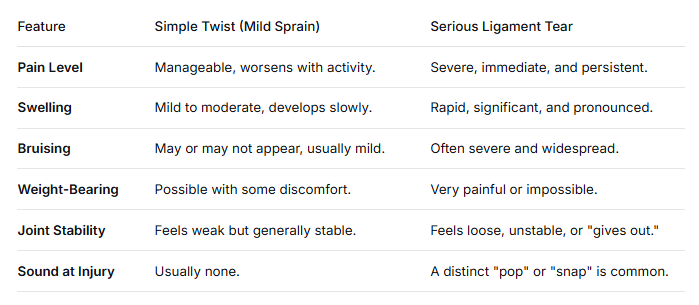
The Aftermath: You’ll likely experience pain, some swelling, and mild to moderate bruising. The joint may feel tender and a bit unstable, but you can usually still put some weight on it.
-
Healing Timeline: With proper R.I.C.E. (Rest, Ice, Compression, Elevation), a mild to moderate sprain often improves significantly within a few days to a couple of weeks.
The Serious Injury: A Ligament Tear
A ligament tear is a more severe version of a sprain, where the ligament fibers are partially or completely ruptured. This is a significant structural injury to the joint’s stability.
-
What Happens: The ligament is stretched so violently that a substantial portion or all of its fibers tear. Common examples include an Anterior Cruciate Ligament (ACL) tear in the knee or a high-grade ankle ligament tear.
-
The Aftermath: Symptoms are more intense and distinct. You may hear or feel a “pop” at the time of injury. Severe swelling appears quickly (within hours). The pain is sharp and debilitating, making weight-bearing nearly impossible. The joint often feels profoundly unstable, as if it will “give way.”
-
Healing Timeline: This is not a simple “walk it off” injury. Partial tears require prolonged rest and often physiotherapy. Complete tears may necessitate bracing, extensive rehabilitation, and sometimes surgical intervention to restore stability.
Key Differences at a Glance
When to Absolutely See a Doctor:
If you experience severe pain, cannot walk, have significant deformity, or if symptoms don’t start improving within 2-3 days of self-care, consult a specialist immediately. Ignoring a serious tear can lead to chronic instability, arthritis, and recurrent injuries.
About Dr. Chetan Oswal – Top Foot and Ankle Specialist in Pune, Maharashtra
Seeking expert care, Dr. Chetan Oswal is a trusted foot and ankle doctor in PCMC, Pune specializing in the diagnosis and management of complex musculoskeletal injuries. Dr. Chetan Oswal provides accurate diagnosis—whether it’s a simple ankle sprain or a severe ligament tear—and creates personalized treatment plans that range from advanced non-surgical interventions to precise surgical repairs. If you are looking for a foot and ankle surgeon in Pune or an ankle injury specialist in Pune – Dr. Chetan Oswal’s expertise offers a clear path to regaining strength, stability, and mobility.
Frequently Asked Questions
1. How do I know if I tore a ligament in my ankle?
Look for a loud “pop” at injury, rapid and severe swelling, an inability to put weight on the foot, and a feeling that the ankle is unstable or giving way.
2. Can a torn ligament heal on its own?
Mild sprains can, but moderate to severe tears often cannot fully heal without proper medical intervention like bracing, physiotherapy, or sometimes surgery, as they need stability to repair correctly.
3. What does a torn ligament feel like?
It typically feels like a sharp, intense pain with a sensation of joint looseness or instability. You may experience significant bruising and difficulty moving the joint.
4. How long does a ligament tear take to heal?
Recovery varies: mild sprains take 1-3 weeks, moderate tears 3-6 weeks with therapy, and severe or surgical tears can require 3-6 months or more of rehabilitation.
5. Is a sprain worse than a tear?
No. “Sprain” is the umbrella term for ligament injury, graded from I (mild stretch) to III (complete tear). A Grade III tear is the most severe type of sprain.